
A casino advertises a $100 bonus with 30x wagering. Most players read that as “$100 free, with some conditions.” It isn’t. Depending on how those conditions are written, that same $100 headline can be worth roughly $20 to you, or it can be worth less than nothing.
The difference isn’t hidden. It’s in the terms, and it comes down to four things: what the multiplier applies to, which games count toward it, how long you have, and whether there’s a cap on what you can withdraw. This guide works through each with real numbers so you can price an offer yourself in about two minutes.
What a wagering requirement actually is
A wagering requirement, also called a playthrough requirement, is the total amount you must stake before bonus funds convert to withdrawable cash.
The critical word is total. It’s cumulative turnover, not money lost. If you stake $1 a hundred times, you’ve generated $100 of turnover regardless of whether you’re up or down at the end. Every spin counts, including the ones you win.
That’s why a requirement can be cleared at all. If it meant losses, nobody would ever finish one.
Bonus-only vs deposit plus bonus
This single distinction changes the value of an offer more than the headline multiplier does, and it’s usually one line deep in the terms.
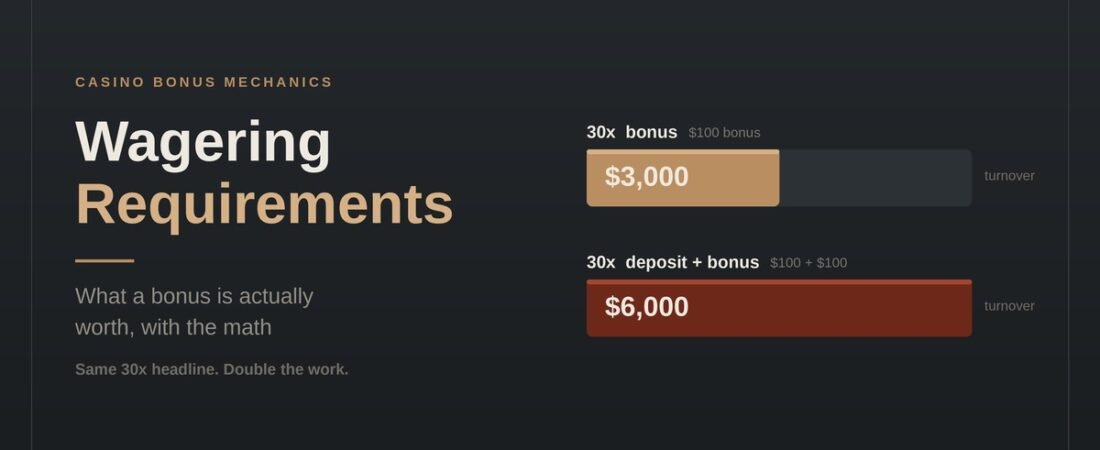
Take a $100 deposit matched with a $100 bonus, advertised at 30x:
| Terms say | Calculation | Turnover required |
|---|---|---|
| 30x bonus | 30 × $100 | $3,000 |
| 30x deposit + bonus | 30 × $200 | $6,000 |
Same advertised number, double the work. An operator offering “30x (D+B)” is asking twice as much of you as one offering “30x (B)”, and the marketing on both will look identical.
When you’re comparing two offers, convert both to a turnover figure in dollars before you compare anything else. A 40x bonus-only requirement ($4,000) is a better deal than a 25x deposit-plus-bonus requirement ($5,000), even though 25 looks smaller than 40.
What the turnover costs you
Here’s the part most bonus guides skip. Generating turnover isn’t free. Every dollar you stake gives back slightly less than a dollar on average, and that gap is the house edge.
A slot advertising 96% RTP returns $0.96 per $1 staked over the long run, so the house edge is 4%. Run $3,000 of turnover through it and your expected loss is:
$3,000 × 4% = $120
You were given a $100 bonus and it costs an expected $120 to unlock. The offer is worth about minus $20 before you account for variance.
This gives you a clean way to price any offer. A bonus is worth taking when:
bonus amount > house edge × required turnover
Rearrange it and you get a threshold worth memorizing. For a bonus-only requirement, the break-even multiplier is 1 divided by the house edge. At a 4% edge that’s 25x. Below 25x bonus-only, a slots bonus is positive value. Above it, you’re paying for the privilege.
For deposit-plus-bonus terms with an equal match, halve it. The break-even lands around 12.5x, which means almost every deposit-plus-bonus offer on the market is negative value if you play it out on slots.
Game weighting, and the trap inside it
Not every game contributes equally. A weighting table decides how much of each dollar staked counts toward the requirement. Typical weightings look like this:
| Game | Typical weighting | $1 staked counts as |
|---|---|---|
| Slots | 100% | $1.00 |
| Roulette | 20% or excluded | $0.20 |
| Video poker | 10–20% | $0.10–$0.20 |
| Blackjack | 10% or excluded | $0.10 |
| Live dealer tables | Often excluded | $0.00 |
Now the counterintuitive part. Players often reason that blackjack has a much lower house edge than slots, so it must be the cheaper way to clear a bonus. Run the numbers and the opposite is true.
To clear that same $3,000 requirement:
- Slots at 100% weighting, 4% edge. You stake $3,000. Expected cost: $3,000 × 4% = $120.
- Blackjack at 10% weighting, 0.5% edge. Because only a dime of each dollar counts, you must stake $30,000 to register $3,000 of progress. Expected cost: $30,000 × 0.5% = $150.
The low-edge game is the more expensive route, because the weighting multiplies your required turnover by ten and that outweighs the edge advantage. Weighting is doing more work than the house edge, and it’s the number most players never look at.
Max bet rules
Most bonus terms cap the stake you’re allowed while a requirement is active, commonly at $5 per spin or hand, sometimes as a percentage of the bonus.
Breaching it rarely produces a warning. The standard consequence is forfeiture of the bonus and everything won with it, and it’s enforced at withdrawal, which is the worst possible moment to discover the rule. One $10 spin on a $5 cap can void a balance built over hours of compliant play.
Watch for two things that catch people out. Feature buys, where you pay a multiple of your stake to trigger a bonus round, usually count as a single large bet and blow through the cap instantly. And doubling or splitting in blackjack can push your total committed stake past the limit even when the initial bet was compliant.
Time limits
Requirements expire, typically between 7 and 30 days. Whatever is unconverted at expiry is removed, usually along with winnings derived from it.
Check whether the clock is realistic before opting in. A $6,000 turnover requirement over 7 days at $2 a spin is 3,000 spins, roughly 8 to 10 hours of continuous play. If you’re a casual player with an hour on weeknights, that offer is not designed for you, and taking it means locking your deposit behind a target you won’t hit.
Maximum cashout caps
A max cashout limits what you can withdraw from bonus play regardless of what you actually won. It’s most common on no-deposit and free-spin offers, and it’s frequently expressed as a multiple of the bonus.
A $25 no-deposit bonus with a 5x max cashout caps your withdrawal at $125. Hit a $4,000 jackpot while clearing it and you withdraw $125. The remainder is removed.
Operators do disclose this, but it changes what the offer is. A capped bonus is a small, bounded prize, not a lottery ticket, and it should be evaluated as one.
Excluded games and payment methods
Two smaller clauses that cost people real money.
Excluded games contribute nothing at all, as distinct from contributing at a reduced weighting. Jackpot slots and live dealer tables are the usual exclusions. Playing an excluded game doesn’t just fail to progress your requirement; under many terms it’s a breach that voids the bonus outright.
Excluded payment methods disqualify the bonus at the point of deposit. E-wallets are the common exclusion, and the disqualification is usually silent. You deposit, no bonus appears, and support points at a clause. Check the accepted methods before funding, not after.
Pricing an offer in two minutes
Six questions, in order. Any one of them can kill an offer on its own.
- Does the multiplier apply to bonus, or deposit plus bonus? Convert to a dollar turnover figure.
- What’s the weighting on the games you’ll actually play? Divide your turnover by the weighting to get real required stake.
- Multiply that stake by the house edge. If the result exceeds the bonus, the offer is negative value.
- Is the max bet workable? Divide required stake by the cap to see how many rounds that is.
- Is the time limit realistic at your actual playing pace?
- Is there a max cashout, and does it change what you’re playing for?
Worked through on our earlier example: 30x on deposit plus bonus is $6,000 turnover; on 100%-weighted slots at 4% edge that’s an expected cost of $240 to unlock a $100 bonus. You’d decline that. The same $100 bonus at 15x bonus-only is $1,500 turnover and an expected cost of $60, which is worth taking.
When to skip the bonus entirely
Most operators let you decline a bonus and play with a straight deposit. That’s frequently the better choice, and it’s worth knowing why.
Accepting a bonus locks your entire balance, deposit included, until the requirement is met. Decline it and you can withdraw at any point, play any game at any weighting, stake what you like, and stop when you want.
If you’re depositing $50 for an evening’s entertainment, a bonus that ties that $50 to $3,000 of turnover is not a gift. It’s a condition attached to your own money. The flexibility is usually worth more than the headline.
Playing responsibly
Wagering requirements are structurally designed to keep you playing longer than you planned, and chasing an unmet requirement is one of the most common routes into problem play. If you find yourself depositing again to finish a playthrough, the bonus has stopped being a bonus.
Set deposit and session limits in your account before you take an offer. If gambling is becoming a problem, the National Council on Problem Gambling runs a confidential helpline on 1-800-522-4700.
Frequently asked questions
What does 30x wagering mean?
It means you must stake 30 times a specified amount before bonus funds become withdrawable. The amount is either the bonus alone or the deposit plus the bonus, and the terms will say which. On a $100 bonus, 30x on the bonus is $3,000 of turnover; 30x on deposit plus bonus with a $100 deposit is $6,000.
Do I have to lose that much money?
No. Wagering requirements count total amount staked, not amount lost. Winning bets count toward the requirement exactly the same as losing ones, which is why clearing one is possible at all.
Which games clear a bonus fastest?
Slots, because they usually carry 100% weighting, so every dollar staked counts fully. Table games are commonly weighted at 10% to 20%, meaning you’d need five to ten times the turnover for the same progress, which typically costs more overall despite their lower house edge.
Is a casino bonus ever worth taking?
Yes, when the bonus exceeds the house edge multiplied by the required turnover. On 100%-weighted slots at a 4% edge, that means bonus-only requirements below roughly 25x are positive value. Deposit-plus-bonus terms need to be around half that to break even.
What happens if I exceed the maximum bet?
The standard penalty is forfeiture of the bonus and any winnings from it, and it’s normally enforced when you try to withdraw rather than at the moment of the breach. Feature buys and blackjack doubling or splitting are common accidental causes.
Can I withdraw before finishing the wagering requirement?
Usually only by forfeiting the bonus and anything won with it. Some operators return your remaining deposit, others deduct the bonus amount first. Check the cancellation clause before opting in, because accepting a bonus generally locks your deposit as well.
18+. Gambling involves risk. Terms vary between operators, and the figures here are illustrative examples rather than the terms of any specific offer. Always read the current bonus terms before opting in.