
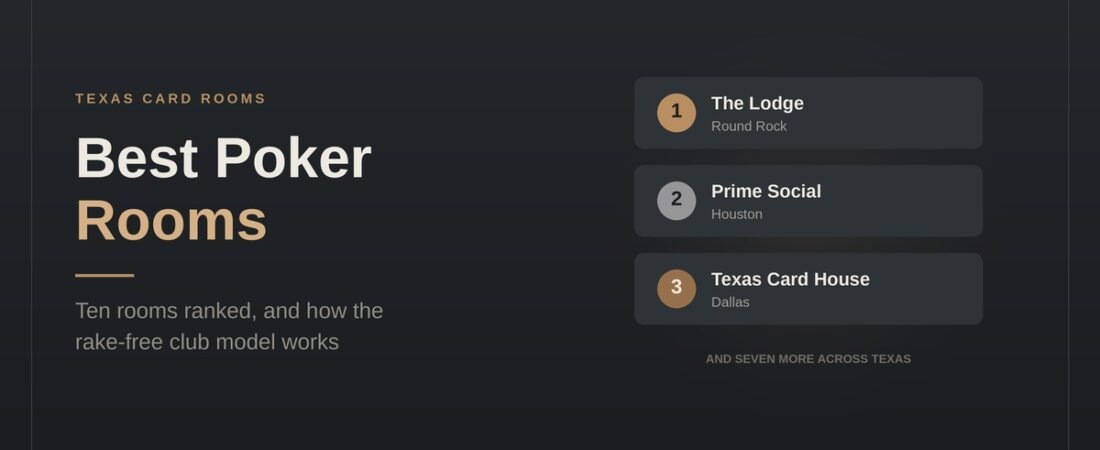
Texas has one of the largest live poker scenes in the United States, which surprises people who know that casino gambling is illegal here. The reason is a specific legal structure: private membership clubs that charge for access and seat time rather than taking a cut of the pot.
That distinction shapes everything about playing here, including which rooms are worth your time. This guide covers the ten rooms we would actually recommend across Austin, Houston, Dallas and San Antonio, and explains the membership model well enough that your first visit isn’t a surprise.
How the Texas club model works
Texas Penal Code Chapter 47 makes it an offense to profit from operating a gambling enterprise. The critical word is profit, and specifically the traditional way poker rooms make money: raking a percentage from each pot.
Texas clubs avoid this by never touching the pot. Instead they charge for membership and for time at the table, typically a membership fee plus an hourly seat rate. The club’s revenue is unrelated to how much money changes hands in the game, which is what keeps the arrangement on the right side of the statute. The legal position has been tested and remains contested in places, so individual rooms have opened and closed over the years, but the model itself has now operated at scale for some time.
For you as a player, it plays out like this:
- You pay by the hour, not by the hand. Short sessions are relatively expensive and long ones are relatively cheap, which is the opposite of a raked game.
- Rake-free play changes the math. Marginal winning hands stay winning, and small-stakes games are considerably more beatable than the raked equivalent online.
- Membership is required. Most rooms need ID and a signup, some offer day passes, and a few require applying in advance.
The second point deserves emphasis. Rake is the single largest cost most low-stakes players face, and removing it is a real structural edge. A break-even player in a raked game is a modest winner in the same game without rake.
The ten best poker rooms in Texas
1. The Lodge Card Club, Round Rock
The best-known room in the state, and the one most visitors have already seen footage of. The Lodge is co-owned by Doug Polk, Brad Owen and Andrew Neeme, and a good deal of its content ends up on YouTube, which keeps a steady stream of recreational players coming through the door.
It is also the largest poker room in Texas by table count, which matters more than the celebrity ownership. Scale means games run at hours when smaller rooms have gone quiet, and it means the tournament series actually fill. Expect deep no-limit cash games, daily tournaments and regular high-stakes pot-limit Omaha.
2. Prime Social, Houston
Houston’s flagship. Prime Social runs the largest tournament guarantees in the city and hosts private mixed games that don’t appear on any public schedule.
The player pool skews experienced, so if you’re stepping up in stakes this isn’t the softest room in Texas. What it does offer is reliable structure, professional dealers and games that stay good deep into the night.
3. Texas Card House, Dallas
Texas Card House operates across Dallas, Austin, Houston and Edinburg, and the Dallas location is the most consistent of them for daily cash. The membership model is a yearly fee plus hourly seat time.
The appeal here is reliability, not spectacle. Games run to a predictable schedule, the skill level sits in the middle of the range, and you can plan a session around it without checking whether anything is actually going.
4. The Lodge Card Club, San Antonio
Formerly Rounders Card Club, now operating under The Lodge brand. The rebrand brought a larger floor and a more serious tournament schedule to a city that was previously underserved.
It is still establishing itself relative to the Austin location, which for now means softer games than the brand’s reputation might lead you to expect.
5. TCH Social, Las Colinas
The Las Colinas room serves the Irving and north Dallas corridor, and it is the more polished of the area’s options in terms of room and staff.
Cash games run at a decent standard without being punishing, which makes it a reasonable choice if you want a well-run room without the tougher lineups you would find at the state’s flagship venues.
6. TCH Social, Austin
Austin’s alternative to The Lodge, and deliberately positioned as the more approachable of the two. Games are mostly $1/$2 no-limit with some pot-limit Omaha, and the room runs daily promotions and freerolls.
If you’re newer to club poker, this is an easier first visit than a room built around livestreamed high-stakes action.
7. Spades Poker House, Houston
Locations in Webster and Baytown, and a different atmosphere from the Houston flagships. This is a grinder’s room: less polish, fewer amenities, and pot-limit Omaha games that tend to run loose.
Occupancy holds up late, good to know if your schedule pushes your sessions past midnight.
8. Champions Club Texas, Houston
A smaller, higher-end room operating inside a boutique hotel, with a focus on livestreamed cash games and particularly pot-limit Omaha.
The room is quiet and well kept, and the trade-off is fewer tables and a narrower range of games running at any given time. Check what is going before making the trip.
9. San Antonio Card House
The city’s long-standing community room, predating the arrival of the larger brands. Daily low and mid-stakes tournaments plus friendly cash games.
It is the steadier option in San Antonio, and the regulars are a significant part of why people keep going back.
10. Georgetown Poker Club
Just north of Austin, and it picks up players who find The Lodge too busy or too far. A small, tight-knit room with solid daily action at low stakes.
Worth the drive if you are based north of the city and mainly playing $1/$2 or small tournaments.
Choosing between them
The right room depends on what you’re actually looking for, and the differences are larger than the rankings suggest.
- Big tournament series: The Lodge in Round Rock or Prime Social in Houston
- The highest stakes: The Lodge and Prime Social again, plus Champions Club for Omaha
- Dependable daily cash: Texas Card House Dallas or TCH Social Las Colinas
- A softer, more social game: TCH Social Austin or San Antonio Card House
- Late-night action: Spades Poker House in Houston
One practical note that applies everywhere: check the room’s live game list before traveling. Most Texas clubs post current games on PokerAtlas or their own apps, and a forty-minute drive to find a single short-handed table is an avoidable mistake.
Playing online instead
If you aren’t near any of these rooms, or you want to play outside club hours, there are two options open to Texans:
- Clubs Poker is a sweepstakes platform, free to play, with prize redemption through Sweeps Coins. Legal under the sweepstakes model instead of gambling law.
- Ignition Poker is an offshore real-money room that accepts U.S. players, with a welcome bonus of up to $3,000. It operates outside U.S. regulation, which is a real consideration.
The differences between the two, and the legal position of each, are covered in our guide to playing online poker in Texas.
Before your first visit
Bring photo ID, since every club requires it for membership. Expect to pay a membership fee and an hourly rate, and factor that into your session cost, particularly if you are only planning to play for an hour or two.
Beyond that, Texas club games are generally friendlier than their online equivalents. The rake-free structure attracts serious players, but the membership model also attracts a recreational crowd who treat it as a night out. That mix is the reason the Texas scene is worth playing in at all.
Frequently asked questions
Is it legal to play poker in a Texas card room?
Yes. Private membership clubs charge membership and hourly seat fees instead of raking pots, so the club’s revenue is unrelated to the money wagered. Texas Penal Code Chapter 47 prohibits profiting from operating a gambling business, and the membership model is structured to fall outside that.
Do Texas poker rooms take rake?
No, and this is the defining feature of the Texas model. Rooms charge for time at the table instead, typically a membership fee plus an hourly seat rate. For players this is a real structural edge, since rake is the largest cost most low-stakes players face.
How much does it cost to play in a Texas card room?
Costs vary by room but follow the same shape: a membership fee, either daily or annual, plus an hourly seat charge while you play. Because you pay by the hour instead of by the hand, short sessions are relatively expensive and long ones relatively cheap.
Which is the biggest poker room in Texas?
The Lodge Card Club in Round Rock, just outside Austin, is the largest by table count. It is co-owned by Doug Polk, Brad Owen and Andrew Neeme, and the associated streaming presence brings a steady flow of recreational players through the room.
Do I need a membership to play?
Yes. Every Texas club requires membership and photo ID. Some rooms sell day passes, others require an annual membership, and a few ask you to apply in advance. Bring ID on a first visit and budget for the fee on top of your buy-in.
Can I play online poker in Texas instead?
There is no regulated real-money online poker in Texas, but sweepstakes platforms and offshore rooms are both accessible. The legal position of each is covered in our guide to playing online poker in Texas.